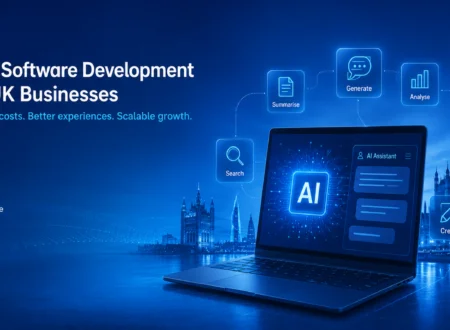


Artificial intelligence is reshaping software engineering, not only through the products companies build, but also through the way development teams work every day. At RabIT, AI is part of how we design, build, test, document, and deliver software. We use it to improve engineering efficiency, support better decision-making, and reduce time spent on repetitive tasks across the software development lifecycle.
Our AI-first software development approach combines experienced software engineers with AI-assisted workflows to create reliable, scalable solutions around real business needs. By embedding generative AI for software development into daily engineering practice, our teams can move faster, work more efficiently, and focus more of their time on architecture, business logic, and complex problem-solving.
AI as Part of the Daily Engineering Workflow
At RabIT, AI is not limited to the solutions we build for clients. It is also embedded into the way our teams work internally across the full software delivery lifecycle. We use AI where it brings practical value: helping teams process information faster, reduce manual effort, and move through everyday engineering tasks with greater efficiency.
In practice, this means AI can support multiple stages of delivery, from early planning and technical discovery to implementation, testing, documentation, and project handover. For example, it can help developers break down technical questions, summarize large amounts of information, explore possible implementation approaches, or speed up routine development work. In parallel, it can support QA preparation, documentation drafting, and internal knowledge organization.
This does not turn development into an automated process. What it does is remove friction from the workflow. Instead of spending unnecessary time on repetitive or low-leverage tasks, engineers can focus more directly on the areas where experience and technical judgment matter most. That makes the overall delivery process faster, clearer, and more efficient without reducing engineering depth.
This includes:
- planning and technical research
- understanding existing systems and codebases
- coding, debugging, and refactoring
- testing and quality assurance
- technical documentation
- project delivery and internal knowledge sharing
The goal is practical: use AI where it adds measurable value and helps teams spend less time on repetitive effort and more time on high-impact engineering work.
AI-Assisted Development
Software development involves far more than writing new code. In many projects, a large portion of engineering time is spent understanding what already exists, how systems interact, where hidden dependencies are located, and what impact even a small change may have elsewhere in the application. Teams often work with legacy code, incomplete documentation, mixed coding styles, or business logic that has evolved over years. In these situations, progress depends not only on implementation speed, but on how quickly developers can build an accurate understanding of the system.
AI can help reduce that overhead. It can support developers in exploring unfamiliar codebases, summarizing logic, identifying relevant sections of code, and speeding up early-stage investigation when an issue needs to be understood quickly. It can also help generate implementation drafts, suggest refactoring directions, and accelerate repetitive coding tasks that do not require deep architectural thinking from scratch each time.
This is especially useful in cases where speed matters but quality still needs to remain high. A developer might use AI to generate a first version of a service method, propose unit test scenarios, or suggest a cleaner structure for an overly complex function. In another situation, AI may help compare alternative implementation approaches or support debugging by surfacing likely causes worth investigating first.
The benefit is not simply faster code generation. The larger advantage is that AI helps reduce context-switching and shortens the path from problem identification to a workable solution. That gives development teams more space to focus on refinement, maintainability, system fit, and business relevance.
AI can make these tasks more efficient by helping with:
- code generation for repetitive or well-defined tasks
- code explanation and codebase exploration
- debugging support and issue investigation
- refactoring suggestions
- implementation drafts
- faster analysis of technical alternatives
Used well, these capabilities can shorten development cycles and reduce friction in day-to-day engineering work. Developers can reach a solid starting point faster and spend more time refining the solution in the context of the wider system. Generative AI for software development is especially valuable here because it supports both speed and technical clarity during implementation work.
AI-Supported Testing and Quality Assurance
Testing and QA benefit significantly from AI-assisted workflows, especially in projects where coverage, speed, and complexity all matter. Quality assurance rarely consists of running a fixed set of checks. It involves understanding features in context, identifying where failures are most likely to happen, considering unusual input combinations, and preparing validation scenarios that reflect real user behavior as well as technical risk.
AI can help teams accelerate this preparation work. It can assist in generating test case ideas, identifying possible edge cases, outlining high-risk user flows, and organizing validation scenarios in a more structured way. This is particularly useful when a feature affects multiple components, introduces new business rules, or requires regression awareness across existing functionality.
It can also support the early stages of test automation by helping outline test structures, propose scenarios worth automating, or generate first-draft test logic that QA specialists and developers can refine further. In documentation-heavy environments, AI can also make it easier to structure test notes, summarize expected outcomes, and improve traceability between requirements and testing effort.
The practical outcome is better preparation and broader initial coverage with less manual overhead. This helps teams spend more time on meaningful validation and less time on repetitive setup work.
AI can support teams by helping them:
- generate initial test case ideas
- identify potential edge cases
- highlight risky scenarios or weak points
- support regression planning
- structure test documentation
- accelerate preparation for test automation
This allows QA specialists and developers to work through validation tasks more efficiently and with broader initial coverage. It is particularly useful in early analysis, test design, and identifying areas that require closer attention.
AI-Accelerated Project Delivery
Project delivery depends on much more than implementation alone. Even well-built software can be slowed down by unclear documentation, fragmented technical knowledge, inefficient research, or delays in aligning teams around the right decisions. A significant part of successful delivery comes from how quickly and clearly information moves through the project.
AI is useful in exactly these supporting layers of delivery. It can help teams summarize research findings, compare technical options, organize internal notes, and draft documentation that would otherwise take substantial time to prepare manually. It can also support meeting follow-ups, structure engineering discussions into more usable written output, and make technical knowledge easier to reuse across the team.
This has a direct effect on project momentum. Developers spend less time reconstructing context. Teams can move more quickly from discussion to action. Documentation becomes easier to maintain. Knowledge is less likely to stay trapped in individual heads or scattered across unstructured notes.
Over time, this contributes to a more efficient delivery model overall. Not because AI replaces project discipline, but because it strengthens the operational side of software engineering in ways that are immediately useful.
AI supports these areas by helping teams:
- compare technical approaches more quickly
- summarize findings from research or discovery work
- prepare technical documentation drafts
- structure engineering notes and internal knowledge
- reduce routine delivery-related workload
This improves information flow within teams and helps projects progress with greater clarity and momentum. In delivery-focused environments, generative AI for software development also helps teams reduce supporting overhead around research, coordination, and documentation.
Short Checklist: Where AI Adds the Most Value
A simple way to evaluate AI use in software development is to ask whether it helps the team:
- reduce repetitive manual work
- speed up analysis or investigation
- improve visibility into complex code or systems
- prepare documentation or test materials faster
- support implementation without lowering quality
- free up engineering time for higher-value decisions
If the answer is yes in several of these areas, AI is likely creating practical value in the workflow.
Why AI-Supported Development Works Better
As software systems become more complex, engineering teams are expected to balance delivery speed with maintainability, security, quality, integration requirements, and long-term scalability. AI helps teams handle this complexity more effectively by improving efficiency at multiple points in the workflow.
Some of the main advantages include:
Faster execution
AI reduces the time spent on repetitive and time-intensive tasks.
Better support for analysis
Teams can explore options, understand unfamiliar code, and process technical information more quickly.
More focus on high-value work
With less time spent on routine tasks, developers can focus more on design, problem-solving, and business-critical logic.
Improved consistency
AI can help structure first drafts of documentation, tests, and implementation patterns in a more standardized way.
Stronger team efficiency
Teams can work more effectively without sacrificing depth, quality, or delivery discipline.
In this sense, AI is not just a productivity tool. It also helps engineering teams operate with greater leverage.
The Role of Human Judgment in AI-Assisted Engineering
AI can accelerate many parts of software delivery, but effective use still depends on engineering judgment, context, and validation.
This matters for several reasons:
- business requirements often involve nuance that goes beyond technical correctness
- implementation choices need to reflect architecture, maintainability, and long-term goals
- generated outputs still need review in the context of the full system
- quality, security, and delivery standards require professional oversight
The strongest results come from combining AI-assisted speed with experienced engineering decision-making. That balance makes it possible to move faster while keeping delivery standards high.
How to Introduce AI into Software Development Workflows
Introducing AI successfully is not only about selecting tools. It also requires clear processes, useful guardrails, and practical adoption across the team.
1. Start with the right use cases
AI delivers the most value in areas such as:
- boilerplate coding
- documentation drafting
- test case ideation
- debugging support
- code explanation
- technical research
2. Define review and validation points
It should be clear where AI-generated or AI-assisted output needs human review, technical validation, or approval before moving forward.
3. Integrate AI into existing workflows
AI is most effective when it supports established engineering processes, including development, QA, documentation, discovery, and internal collaboration.
4. Train teams to use it well
Teams should know how to use AI tools effectively, evaluate outputs critically, and apply them in ways that improve speed without introducing avoidable quality risks.
5. Measure practical outcomes
Track where AI contributes tangible value, such as faster development of routine tasks, quicker documentation preparation, or more efficient testing workflows.
6. Use it deliberately
The point is not to automate everything. The point is to improve delivery where AI can make a meaningful difference.
FAQ
What does AI-assisted software development mean?
It means using AI-supported tools to help with coding, debugging, refactoring, testing, research, and documentation as part of the software delivery process.
What are the main benefits of AI in software engineering?
The main benefits include faster execution, reduced repetitive work, better support for technical analysis, improved workflow efficiency, and more time for high-value engineering tasks.
Where is AI most useful in daily development workflows?
It is especially useful in development support, QA preparation, documentation, debugging, technical research, and understanding complex codebases.
How can teams introduce AI effectively?
By starting with practical use cases, integrating AI into existing workflows, setting clear validation points, and training teams to use the tools well.
Does AI improve project delivery?
Yes. Used in the right way, AI can speed up research, documentation, testing preparation, and implementation support, helping teams deliver more efficiently.
Conclusion
AI is becoming an increasingly valuable part of modern software engineering workflows. When used deliberately, it helps teams reduce repetitive work, improve delivery speed, and operate more efficiently across development, testing, documentation, and project execution.
At RabIT, we integrate generative AI for software development into daily engineering practice as a practical tool for better delivery. Combined with strong engineering expertise, it helps our teams build reliable, scalable solutions with greater speed and focus.