

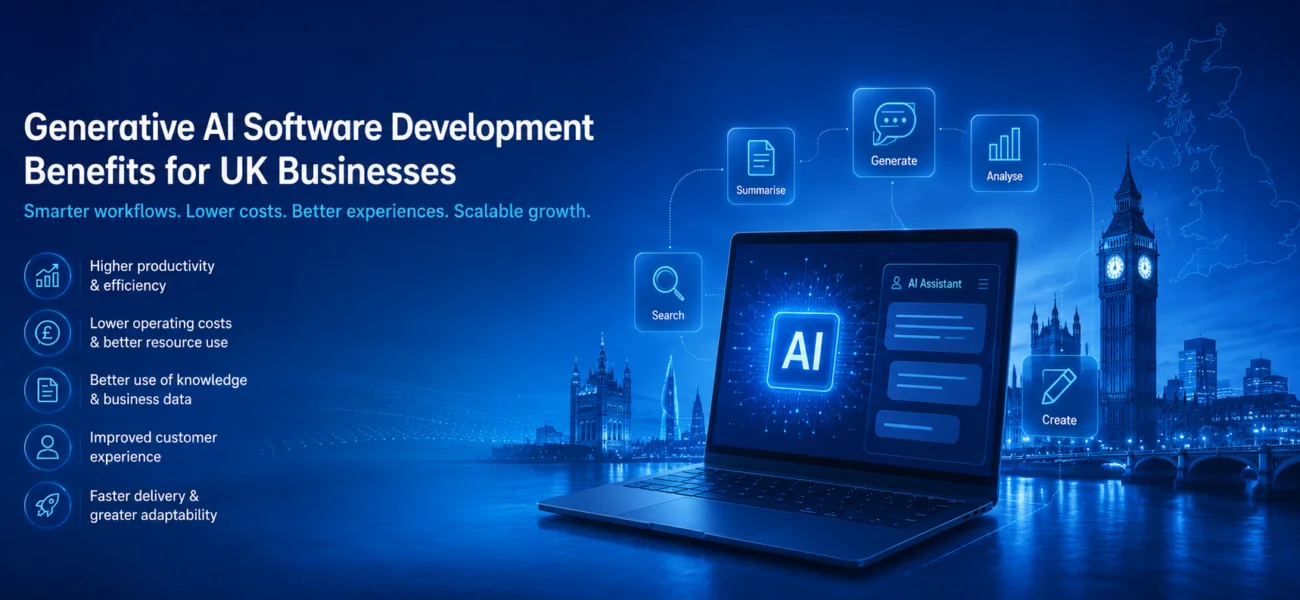
Generative AI software development benefits are becoming increasingly relevant for businesses that want to automate work, improve decision-making, and get more value from their data. For UK companies facing growing competition, cost pressure, and rising expectations around digital transformation, generative AI can support measurable outcomes such as higher productivity, lower operating costs, better customer experiences, and more scalable growth.
The value of generative AI is strongest when it is applied to specific business problems, such as repetitive manual work, slow internal processes, fragmented data, inconsistent customer support, or inefficient content and document workflows. In these situations, tailored AI development and consulting services can help companies turn data and business knowledge into practical tools that support both day-to-day operations and long-term performance.
In this article, we cover:
- the main generative AI software development benefits for UK businesses,
- common enterprise use cases across key industries,
- how to evaluate AI project ROI,
- and what to look for when choosing a generative AI development partner in the UK.
Key Generative AI Software Development Benefits for UK Companies
The main generative AI software development benefits appear when the technology is linked to a clear business goal. Instead of adopting AI because of market hype, UK businesses are getting better results when they use it to solve specific operational, commercial, or customer-facing challenges.
-
Productivity and efficiency gains
One of the clearest benefits of generative AI is its ability to reduce time spent on repetitive tasks. This can include drafting responses, summarising documents, generating internal content, assisting with reporting, supporting customer service teams, or accelerating software-related tasks such as documentation and test case preparation.
By reducing manual effort, teams can spend more time on higher-value work such as problem-solving, decision-making, customer communication, and strategic planning. In practice, this often leads to faster delivery, fewer bottlenecks, and better use of specialist capacity.
-
Lower operating costs and better resource use
Another of the important generative AI software development benefits is cost efficiency. Businesses can reduce the amount of manual effort needed for routine work, minimise avoidable errors, and improve the consistency of outputs across teams and processes.
In many cases, the financial benefit comes not from replacing teams, but from improving throughput, reducing rework, and allowing the business to scale without increasing headcount at the same pace.
-
Better use of internal knowledge and business data
Many organisations have large volumes of internal knowledge spread across documents, systems, emails, support history, and process documentation. Generative AI can help make this information easier to access, summarise, and reuse.
This supports faster decision-making, improves response quality, and reduces time lost searching for information. For many businesses, one of the most practical generative AI software development benefits is turning disconnected knowledge into something teams can actually use in their daily work.
-
Improved customer experience
Generative AI can improve customer experience by enabling faster, more consistent, and more personalised interactions. It can support first-line support automation, help agents respond more quickly, generate draft answers, and deliver more relevant content or recommendations.
When implemented well, this improves responsiveness without reducing service quality. It also helps service teams handle higher volumes more effectively.
-
Faster delivery and greater adaptability
Businesses that can respond quickly to customer needs, market changes, or internal operational issues are better positioned to compete. Generative AI can support this by accelerating content production, streamlining internal workflows, and helping teams move from idea to execution faster.
In software and product environments, it can also support engineering teams through assisted analysis, code-related workflows, documentation, and process automation. These are often among the most visible generative AI software development benefits for companies looking to improve speed without sacrificing quality.
Common Generative AI Use Cases in the UK
Generative AI software development is already creating value across multiple UK sectors. The strongest use cases are usually those where there is a clear business need, enough usable data or knowledge sources, and a realistic path to integration with existing systems.
Retail and eCommerce
In retail and eCommerce, generative AI is often used to improve product discovery, customer communication, and content workflows. It can generate product descriptions, personalise marketing copy, assist support teams with faster responses, and improve the consistency of customer interactions.
It can also support sales and merchandising teams by summarising customer behaviour and helping generate more relevant campaigns or recommendations.
Finance and Fintech
In finance, generative AI is commonly used to assist with document-heavy processes, internal knowledge access, customer communication, and operational efficiency. It can support onboarding workflows, help teams review policies and documentation faster, and improve access to structured and unstructured information.
Because these environments are highly regulated, successful implementation usually depends on strong governance, clear review processes, and careful handling of sensitive data.
Healthcare
In healthcare, generative AI can help reduce administrative burden by supporting documentation, summarisation, communication, and information retrieval. It can help professionals process notes more efficiently and reduce time spent on repetitive admin tasks.
The goal is typically not to replace experts, but to free up time for patient care and improve access to relevant information in fast-moving environments.
Logistics and Supply Chain
In logistics and supply chain operations, generative AI can support operational coordination by summarising disruptions, generating reports, improving communication, and helping teams act faster when conditions change.
When combined with predictive or analytical systems, it can make operational insights easier to understand and easier to act on.
Education
In education, generative AI can support personalised learning materials, draft feedback, content adaptation, and administrative efficiency. It can help educators save time on routine tasks while improving the accessibility and relevance of learning content for students.
How to Evaluate ROI
The business case for generative AI should be measured through outcomes, not novelty. The most effective way to assess value is to compare the current process with the expected improvement after implementation.
A practical ROI model should include:
- Current baseline: time spent, process cost, response time, error rate, or output volume
- Target improvement: expected efficiency gain, quality improvement, or revenue impact
- Level of support or automation: how much manual effort is reduced, accelerated, or improved
- Implementation costs: development, integration, infrastructure, training, rollout, and maintenance
- Operational impact: changes in capacity, throughput, service quality, or customer satisfaction
In many cases, it makes sense to evaluate value in stages:
- Discovery and feasibility – validate the business problem and available data or content sources
- Pilot or MVP – test value on a smaller scope
- Production rollout – measure actual operational impact after adoption
It is also important to stay realistic. Not every process needs generative AI, and not every use case produces immediate returns. Often, the highest ROI comes from focused automation or internal productivity use cases rather than broad transformation programmes.

When Businesses Are Ready to Invest
A company is usually in a strong position to invest in generative AI development services when it has:
- repetitive, knowledge-heavy, or communication-heavy workflows,
- access to usable internal documentation, support data, or business content,
- a clear KPI to improve,
- business ownership for the initiative,
- and a realistic need to integrate AI into existing tools and workflows.
Without these foundations, projects often remain experimental and struggle to create measurable business value.
How to Choose the Right Generative AI Development Company in the UK
Choosing the right partner is about delivery, not buzzwords. A strong vendor should be able to connect generative AI to a real business objective, work responsibly with your data, and deliver a solution that is useful in production, not just impressive in a demo.
Want to learn more about choosing the right generative AI development partner in the UK? We have written a dedicated article to help you evaluate your options. Read it here.
Business understanding and clear success metrics
A strong partner should start with the problem, not the model. They should be able to define success in measurable terms, such as reduced handling time, improved response quality, lower admin workload, or faster internal delivery.
Relevant technical and industry experience
Look for experience with similar workflows, data sensitivity levels, and operational environments. Industry context matters, especially in finance, healthcare, logistics, and education.
Proven case studies and measurable outcomes
Good case studies should show the business challenge, the implemented solution, and the result. Technology alone is not enough.
Security, privacy, and data handling practices
Generative AI projects often involve internal documents, customer data, or sensitive operational knowledge. Your vendor should have clear practices around access control, secure environments, data processing, and compliance expectations.
Transparent scope, pricing, and IP ownership
Make sure responsibilities, pricing structure, support terms, and intellectual property ownership are clearly defined from the start.
Post-launch support and monitoring
Generative AI systems need ongoing evaluation and improvement. That may include prompt refinement, workflow tuning, quality review, analytics, and production support over time.
Summary
The main generative AI software development benefits for UK businesses include higher productivity, lower operating costs, better use of internal knowledge, improved customer experience, and faster response to change.
The strongest results usually come from focused use cases with a clear business goal, realistic implementation scope, and measurable success criteria. Across sectors such as retail, finance, healthcare, logistics, and education, generative AI is already delivering practical value when applied to real workflows and supported properly after launch.
For businesses considering investment, success depends not only on the technology itself, but also on choosing the right use case, preparing the right data and content sources, and working with a development partner that can deliver reliable results beyond the prototype stage.
FAQ
What are the main generative AI software development benefits for businesses?
The main generative AI software development benefits include higher productivity, lower operating costs, better use of internal knowledge, faster customer support, and improved scalability. These benefits are strongest when AI is applied to specific business processes with clear goals and measurable outcomes.
How can generative AI improve productivity in a company?
Generative AI can improve productivity by reducing the time spent on repetitive tasks such as drafting content, summarising documents, preparing reports, and supporting customer service workflows. This allows employees to focus more on decision-making, problem-solving, and other higher-value work.
Which industries benefit most from generative AI software development?
Industries that often see strong results include retail, finance, healthcare, logistics, and education. These sectors usually have knowledge-heavy, communication-heavy, or document-heavy workflows where generative AI can deliver practical efficiency gains.
How do businesses measure the ROI of generative AI projects?
Businesses typically measure ROI by comparing current process performance with post-implementation results. Common indicators include time saved, lower operating costs, faster response times, improved service quality, higher throughput, and reduced manual effort.
Is generative AI suitable for every business process?
No. Generative AI is most effective in workflows that involve language, documents, internal knowledge, or repeated communication tasks. For highly structured, rule-based processes, traditional automation or standard software solutions may be more cost-effective and easier to manage.