

Many software applications continue to work and deliver business value long after their internal structure starts slowing development down.
Features take longer to implement, changes become harder to estimate, regressions appear more often, and developers begin to avoid certain parts of the system altogether.
This is a familiar problem in traditional legacy systems, but it is also increasingly common in applications created quickly with AI-assisted development and vibe coding. These systems may reach a working state fast, but speed of implementation does not automatically result in maintainable architecture, consistent code quality, or safe long-term evolution.
That is where vibe code cleanup becomes valuable.
It is a structured process for improving an existing application so it becomes easier to understand, safer to modify, and more efficient to develop further. Instead of discarding what already works, cleanup focuses on preserving business value while removing the technical friction that slows future progress.
In this article, we will explain what vibe coding cleanup is, why it matters, what problems it helps solve, and why it can often be a better choice than a full rewrite.
What Is Vibe Coding?
Vibe coding is an AI-assisted development approach where software is created or modified through natural-language instructions and code generation tools.
This can be extremely useful for:
- rapid prototyping,
- MVP development,
- testing product ideas,
- creating internal tools quickly,
- accelerating feature delivery.
However, code generated quickly through repeated prompting may not always evolve in a consistent or well-structured way.
Without strong review, architectural discipline, and sufficient testing, an application can become functional but difficult to maintain.
That does not mean AI-generated software is inherently poor. It means that fast delivery still needs structured engineering follow-up if the application is expected to grow.
What Is Vibe Code Cleanup?
It is the process of improving an existing software application, especially one built or heavily modified with AI-assisted development, so that it becomes more maintainable, more consistent, and easier to extend safely.
It is not just about making code look cleaner.
It is a practical engineering effort focused on restoring development capability.
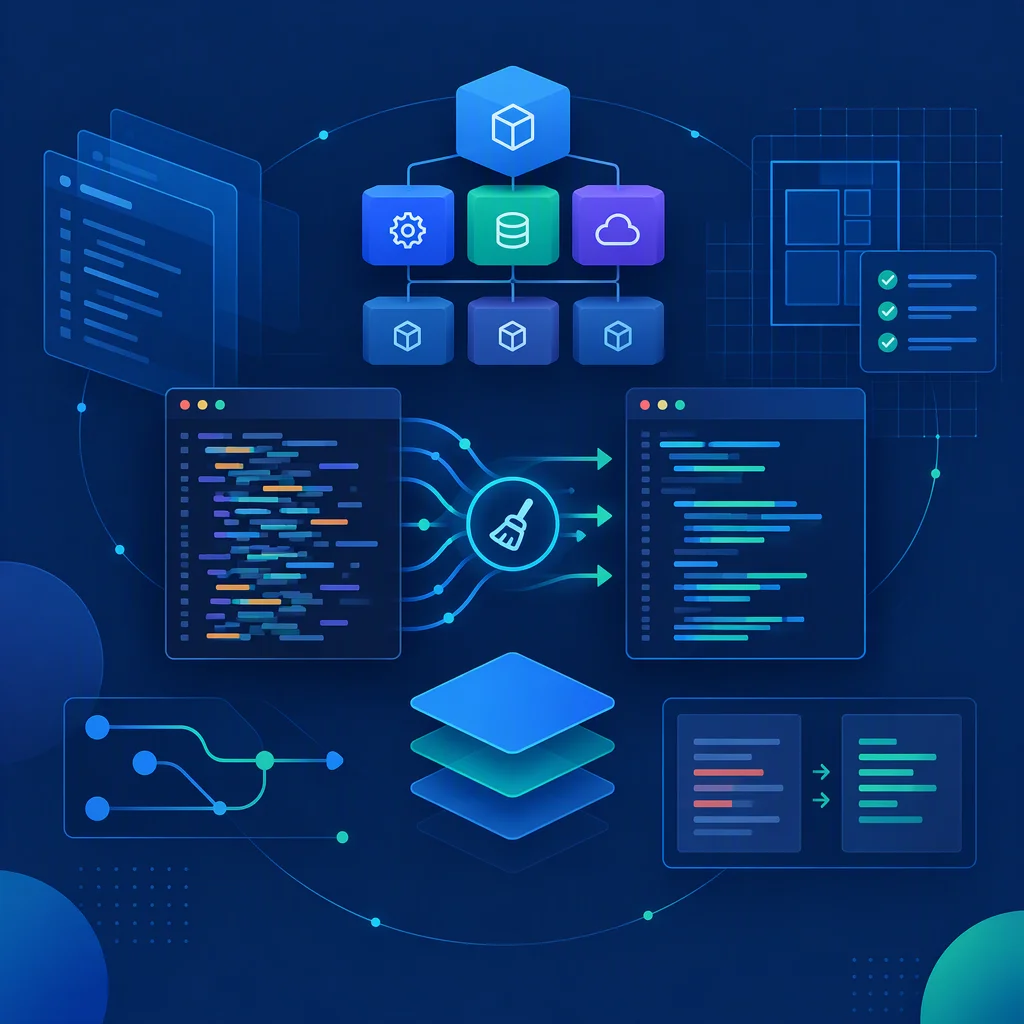
A cleanup process may include:
- refactoring hard-to-follow code,
- reducing duplication,
- improving naming and structure,
- clarifying architectural boundaries,
- fixing recurring defects,
- strengthening tests around critical workflows,
- simplifying dependencies,
- addressing performance or security weaknesses.
The goal is not to rebuild the whole system from scratch. The goal is to improve the parts of the application that create risk, slow delivery, or make future changes unnecessarily difficult.
Why Is It Matters?
Many applications do not fail because they stop working.
They become problematic because they stop supporting efficient development.
That distinction is important.
A system may still contain valuable business logic, stable workflows, and useful integrations, while at the same time becoming slower, riskier, and more expensive to change. In such cases, cleanup is not cosmetic work. It is a way to restore the application’s ability to support future business needs.
A well-executed cleanup helps organizations:
- reduce development friction,
- improve release confidence,
- lower regression risk,
- make implementation effort more predictable,
- support faster onboarding for developers,
- create a safer foundation for future growth.
For many teams, the real problem is not that the application has no value. It is that the current codebase makes every change harder than it should be.
What Problems Does It Help Solve?
Applications usually become difficult to develop for a combination of reasons. Cleanup helps address the most common ones.
1. Duplicated logic and inconsistent implementation
Business rules may be repeated across multiple modules, often with slight variations.
This makes changes harder, increases the risk of defects, and creates inconsistency in behavior.
Cleanup helps by consolidating logic, reducing duplication, and improving structural clarity.
2. Weak architectural boundaries
When features are added quickly over time, modules often begin to take on too many responsibilities. Concerns become mixed, dependencies spread, and small changes start affecting unrelated areas.
Cleanup can restore clearer boundaries between components and reduce hidden coupling.
3. Low confidence in change
If automated test coverage is weak, teams rely too much on manual validation. This slows delivery and makes even simple updates feel risky.
Cleanup often includes targeted test improvements around critical workflows, making change safer and more predictable.
4. Recurring bugs and fragile modules
Some parts of an application repeatedly cause incidents, regressions, or production support overhead. These hotspots consume time that should be spent on forward progress.
Cleanup focuses on stabilizing these high-friction areas and addressing root causes rather than only symptoms.
5. Lost context and poor maintainability
Applications become harder to work with when the original implementation logic is unclear.
This may happen because:
- key developers are no longer involved,
- documentation is missing,
- architectural decisions were never captured,
- AI-generated code introduced changes without preserving rationale.
Cleanup helps teams rebuild understanding through clearer structure, more consistent patterns, and better-defined responsibilities.
6. AI-generated code quality issues
Applications built quickly with AI tools may contain:
- repeated patterns with inconsistent variation,
- overly large functions or components,
- weak separation of concerns,
- shallow error handling,
- missing tests,
- unnecessary complexity introduced by generated code.
Cleanup is especially relevant here because the system may already work, but it needs engineering refinement before it can support long-term development safely.
What Does Vibe Code Cleanup Typically Include?
The exact scope depends on the application, but cleanup commonly includes a mix of the following activities:
- Code refactoring
- Simplifying difficult modules, reducing complexity, and improving readability.
- Duplication reduction
- Removing repeated logic and consolidating shared behavior.
- Test improvement
- Adding or strengthening automated tests around critical business workflows.
- Architectural clarification
- Defining clearer responsibilities between components, services, or modules.
- Bug root-cause fixes
- Addressing repeated problems at their source instead of patching them repeatedly.
- Dependency cleanup
- Removing unnecessary libraries, updating problematic dependencies, or simplifying integrations.
- Validation and error handling improvements
- Making system behavior more predictable and easier to support.
- Performance and security hotspot remediation
- Improving areas that create operational or business risk.
Cleanup should be guided by business priorities, not by abstract technical perfection.
Key Benefits of AI Code Cleanup
A structured cleanup effort can produce both technical and business benefits.
Better maintainability
The application becomes easier to understand, safer to modify, and less dependent on individual developer knowledge.
Faster future development
When the most problematic parts are simplified, each new feature requires less effort and fewer workarounds.
Reduced regression risk
Improved structure and better test coverage lower the chance that small changes will break existing behavior.
More predictable delivery
Teams can estimate and implement changes with greater confidence when the codebase is clearer and more stable.
Improved onboarding
New developers can become productive faster when responsibilities are clearer and the code follows more consistent patterns.
Preservation of existing business value
Cleanup protects the parts of the system that already work, including proven workflows, integrations, and business logic.
Lower operational friction
Stabilizing recurring problem areas reduces support effort, defect recurrence, and release anxiety.
Why Vibe Code Cleanup Can Be Better Than a Full Rewrite
A full rewrite is sometimes necessary, but it is often treated as the default answer too early.
In many cases, the existing application already contains valuable and working business functionality. Replacing everything may introduce more cost, delay, and risk than improving the parts that currently cause problems.
Cleanup can deliver value earlier
A rewrite often requires a long period of parallel investment before business value becomes visible. Cleanup, by contrast, can improve the application in stages and create benefits along the way.
Cleanup preserves what already works
Stable business logic, useful workflows, and reliable integrations do not need to be discarded if they are still serving the business well.
Cleanup usually creates less disruption
Incremental improvement is often easier to manage than replacing an entire system, especially when the application is already supporting day-to-day operations.
Cleanup lowers transformation risk
Full rewrites carry significant risks:
- missing hidden requirements,
- reintroducing already solved problems,
- delayed delivery,
- user disruption,
- underestimated migration complexity.
Cleanup reduces these risks by improving the system while keeping proven functionality in place.
Cleanup supports phased investment
Instead of committing to a large all-or-nothing project, organizations can improve the highest-value areas first and continue based on measurable results.
For many businesses, this makes cleanup a more practical and commercially sound path.
When It Is a Good Choice?
Cleanup is often a strong option when:
- the application still works but is hard to extend,
- small changes take too long,
- regressions happen too often,
- some modules are clearly high-risk or high-friction,
- test coverage is weak around critical flows,
- the business needs improvement without major disruption,
- a full rewrite would be too expensive, too slow, or too risky,
- the system contains business value worth preserving.
In these situations, cleanup can restore development capacity without forcing the business to start over.
When a Full Rewrite May Still Be Necessary
Cleanup is not always the right answer.
A rewrite may be justified when the system has fundamental limitations that cannot reasonably be solved incrementally, such as:
- severe architectural constraints,
- unsupported or unmaintainable platform dependencies,
- major security or compliance issues,
- extreme performance limitations,
- operational instability that cannot be isolated and improved in phases,
- technical fragmentation so deep that targeted improvement is no longer cost-effective.
The key is to make that decision based on realistic assessment, not frustration alone.
How to Approach Vibe Code Cleanup
1. Assess the current state
Review the architecture, code structure, dependencies, testing, recurring defects, critical workflows, and development pain points.
2. Prioritize by impact
Focus first on the areas that create the highest business risk or the greatest delivery friction.
3. Preserve working value
Do not replace components simply because they are old. Keep what is stable and useful.
4. Improve incrementally
Refactor, stabilize, and test the system in controlled steps rather than through a large disruptive effort.
5. Measure progress
Track signs of improvement such as reduced defects, faster delivery, lower regression risk, and clearer implementation effort.
This phased model helps organizations improve an application while continuing to use it.
Short Checklist: Does Your Application Need Cleanup?
Cleanup is likely worth considering if several of these are true:
- small changes take longer than expected,
- developers avoid touching certain modules,
- the same logic exists in multiple places,
- releases regularly introduce regressions,
- automated test coverage is weak in critical areas,
- estimates are increasingly unreliable,
- onboarding new developers takes too long,
- the application works, but extending it feels risky,
- a rewrite seems too disruptive or too expensive.
If this pattern sounds familiar, the issue may not be that the application has no future. It may simply need a structured path back to maintainability.
Conclusion
A difficult codebase does not automatically mean the system should be thrown away.
Many legacy and AI-assisted applications already contain the most valuable part of software development: business logic that works, workflows users depend on, and functionality that has proven itself in real use. The problem is often not the existence of the application, but the fact that technical debt, inconsistent structure, or rapid code generation have made further development harder than necessary.
That is why vibe code cleanup matters.
It helps organizations preserve what already delivers value, improve what creates risk, and restore the development capability needed for future growth. In many cases, it is a faster, safer, and more commercially effective choice than starting from zero.
The right next step is not always a rewrite.
Often, it is a structured cleanup process that makes the existing application workable again.
FAQ
What is vibe coding?
Vibe coding is an AI-assisted development approach where software is created or modified using natural-language instructions and code generation tools.
What is vibe code cleanup?
It is the process of improving an AI-generated or AI-assisted application so it becomes easier to maintain, safer to change, and better suited for future development.
Is ai code cleanup only for AI-generated applications?
No. The same approach can also be useful for traditional legacy systems that have become difficult to maintain or extend.
Does a difficult application always need a full rewrite?
No. Many applications can be improved through phased cleanup, refactoring, testing improvements, and targeted architectural changes.
Can cleanup deliver business value quickly?
Yes. When focused on the highest-impact areas, cleanup can reduce defects, improve release confidence, and speed up future development relatively early.
What should be preserved during cleanup?
Anything that already works well and supports the business, such as stable workflows, useful business logic, reliable integrations, and functioning core features.


