


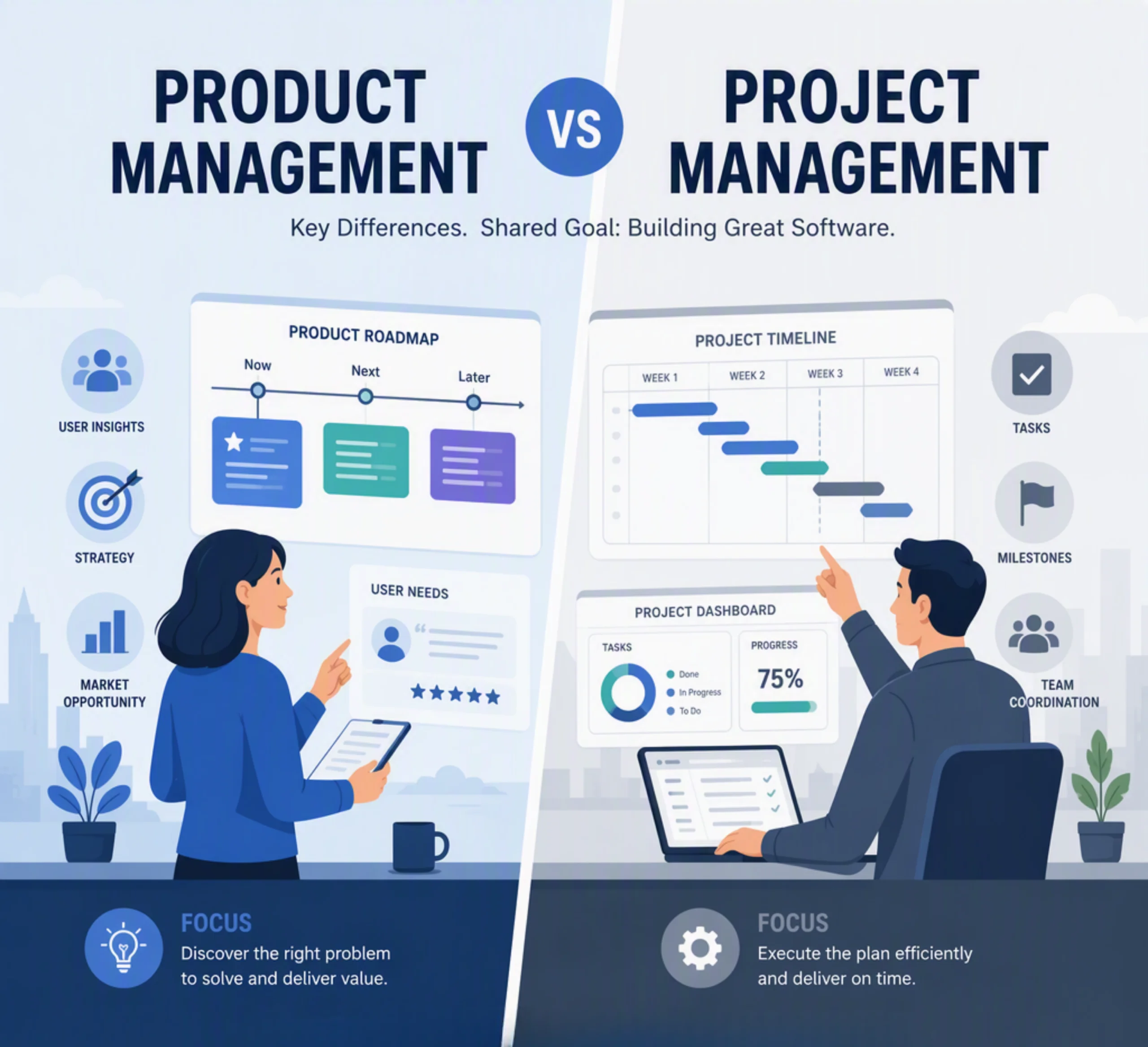
In software development and digital business, project management and product management are both critical roles, but they are not the same. They often work closely together, yet they focus on different priorities and outcomes.
At a high level, project management is about delivering software projects successfully, while product management is about defining product vision and creating long-term product value.
Understanding the difference helps organizations assign responsibilities more clearly, improve collaboration, and build products that are not only delivered on time, but also solve the right problems for users and the business. This is why the topic of product management vs project management is so important for modern teams.
Project Management vs. Product Management at a Glance
| Area | Project Management | Product Management |
|---|---|---|
| Primary focus | Delivering software projects successfully | Defining product vision and creating long-term product value |
| Main responsibility | Managing timelines, resources, budgets, risks, and execution | Managing product strategy, roadmap, features, and user needs |
| Key goal | Ensuring teams stay aligned and projects are delivered as planned | Ensuring the product solves the right problems for users and the business |
| Core question | “How do we deliver this project successfully?” | “What should we build and why?” |
| Success metrics | Successful delivery, coordination, and meeting project goals | Product adoption, customer value, and business impact |
What Is Project Management?
Project management focuses on the planning, coordination, and execution of a specific initiative. In software environments, this often means organizing people, timelines, budgets, dependencies, and risks to ensure a project is delivered according to expectations.
A project manager is responsible for making sure the work moves forward in a structured and predictable way. Their focus is on delivery.
Typical areas of responsibility include:
- creating project plans,
- managing scope and deadlines,
- coordinating teams and stakeholders,
- tracking progress,
- identifying and reducing risks,
- and ensuring the project is completed as planned.
What Is Product Management?
Product management focuses on the direction, value, and evolution of a product over time. Instead of concentrating mainly on delivery mechanics, product managers focus on understanding what should be built and why.
Their role is to connect user needs, business goals, and market opportunities into a clear product strategy.
Typical areas of responsibility include:
- defining product vision,
- building and maintaining the roadmap,
- prioritizing features,
- understanding customer pain points,
- working with design and engineering,
- analyzing usage and feedback,
- and making sure the product delivers meaningful value.
What Does a Product Manager Do?
A product manager is responsible for helping the team build a product that is useful, relevant, and aligned with business goals. The role sits at the intersection of user expectations, commercial priorities, and technical possibilities. Rather than focusing only on delivery, product managers guide what should be built and make sure there is a clear reason behind it.
Defines the vision and strategy
One of the product manager’s main responsibilities is setting a clear direction for the product. This means shaping a vision that explains where the product is heading and how that direction supports broader company objectives.
To do this, product managers look at customer problems, market opportunities, competitor activity, and business priorities. They use this information to create a strategy that helps teams make consistent and informed decisions over time.
Prioritizes the product roadmap
Product managers decide which initiatives deserve attention first and which ones should be postponed or removed from scope. Roadmap prioritization requires balancing several factors, including user impact, business importance, development effort, and strategic fit.
Because conditions change, priorities also change. Product managers regularly review the roadmap and adjust it when new insights, feedback, or business needs emerge.
Conducts user and market research
A strong product decision usually starts with a good understanding of users. Product managers collect information from interviews, analytics, support conversations, feedback channels, and market observation to better understand customer behavior and unmet needs.
They also monitor the broader environment around the product, including industry changes and competitor moves. This helps them identify opportunities earlier and reduce the risk of making decisions based only on assumptions.
Defines requirements and features
Once priorities are clear, product managers turn ideas into something the team can build. They describe features, outline user flows, define expectations, and clarify the problem that each solution is meant to address.
This work often includes writing user stories, preparing acceptance criteria, and collaborating with designers and engineers to make sure requirements are clear. The goal is not just to describe functionality, but to make sure everyone understands the intended outcome.
Collaborates with cross-functional teams
Product managers work across multiple departments and help align different perspectives. They collaborate with engineering on feasibility, with design on user experience, with marketing on positioning and launches, and with sales or support on customer feedback.
Because so many teams contribute to product success, product managers play an important role in maintaining alignment and helping everyone move in the same direction.
Measures product success
After a release, product managers evaluate whether the outcome delivered the expected value. They review metrics such as adoption, engagement, retention, customer response, and business performance to understand what changed and whether the result was meaningful.
This differs from project management, where success is more often measured through delivery-related indicators such as timeline adherence, budget control, milestone completion, resource usage, and overall execution against the original plan. Product managers focus more on whether the release created value, while project managers focus more on whether the work was delivered effectively. In discussions about product management vs project management, this difference in what success looks like is one of the clearest distinctions.
What Does a Project Manager Do?
A project manager is responsible for making sure a defined initiative is delivered in an organized and controlled way. The role is centered on execution: keeping work structured, maintaining momentum, coordinating contributors, and ensuring deadlines and expectations remain visible throughout the project.
Plans projects
Project managers create the framework that guides delivery from start to finish. This usually includes defining scope, establishing milestones, breaking the work into smaller tasks, identifying dependencies, and outlining who is responsible for what.
Good planning also means anticipating problems before they happen. Project managers assess risks early and prepare mitigation plans so the team is better equipped to handle delays, blockers, or changing conditions.
Manages project timelines
A key part of the role is making sure the project progresses according to schedule. Project managers monitor deadlines, review milestone status, and keep track of whether the work is moving at the expected pace.
When timeline risks appear, they step in to replan, escalate, or coordinate corrective action. Their role is not only to monitor dates, but to maintain enough control for delivery to remain realistic and transparent.
Allocates resources
Projects depend on having the right people and enough capacity at the right time. Project managers work with team leads or managers to secure resources, address availability issues, and resolve conflicts when multiple priorities compete for the same people.
This coordination helps reduce overload, supports smoother execution, and makes it easier for teams to focus on the work that matters most.
Facilitates team communication
Project managers support communication across all participants involved in delivery. They organize meetings, share updates, document decisions, and make sure stakeholders understand current status, risks, and next steps.
This becomes especially important when work spans multiple teams or departments. Clear communication improves coordination and helps prevent small issues from turning into larger delivery problems.
Tracks progress and performance
Throughout the lifecycle of the project, project managers monitor how the work is progressing. They review task completion, milestones, risks, dependencies, and other indicators that show whether the project is on track.
If progress starts to drift away from the plan, they investigate the cause and help implement adjustments. This ongoing oversight allows teams and stakeholders to respond early rather than waiting until problems become critical.
Oversees project execution
Project managers remain involved through execution to ensure the plan is being carried out effectively. They follow up on actions, coordinate handovers, help remove blockers, and keep attention on agreed deliverables and deadlines.
They may also support validation, final delivery steps, and closure activities once the work is complete. Their responsibility is to help the initiative reach completion in a way that meets quality expectations and stakeholder commitments.
Why Both Roles Matter
Many organizations make the mistake of treating these roles as interchangeable. In reality, they solve different problems.
Without strong project management:
- deadlines slip,
- coordination breaks down,
- risks are not managed properly,
- and delivery becomes difficult.
Without strong product management:
- teams may build features nobody needs,
- priorities may become unclear,
- the roadmap may lose direction,
- and the product may fail to create business value.
The most effective companies combine both disciplines. Product management ensures the team is solving the right problem. Project management ensures the work is delivered in a controlled and effective way.
For organizations evaluating product management vs project management, the key is not choosing one over the other, but understanding where the biggest gap currently exists.
How Project Managers and Product Managers Work Together
A healthy product organization usually needs close collaboration between the two roles.
A product manager may identify a market need, define a feature direction, and explain why it matters. A project manager may then help coordinate the delivery process, manage schedules, align stakeholders, and track execution.
A simple way to think about it:
- the product manager defines the destination,
- the project manager organizes the journey.
When both roles work well together, teams gain:
- clearer priorities,
- stronger communication,
- better execution,
- lower delivery risk,
- and better business outcomes.
How to Build Better Collaboration Between the Two Roles
If your organization has both project managers and product managers, it is important to define responsibilities clearly.
Separate strategy from execution
Product managers should lead product direction, prioritization, and customer value decisions.
Project managers should lead planning, coordination, risk management, and delivery structure.
Align on goals early
Before execution starts, both roles should agree on:
- expected outcomes,
- timeline expectations,
- key risks,
- dependencies,
- and stakeholder involvement.
Use shared communication practices
Regular check-ins, roadmap reviews, milestone tracking, and status updates help avoid confusion and misalignment.
Focus on outcomes, not only outputs
A project can be delivered on time and still fail if it does not solve a meaningful problem. Teams should evaluate both delivery performance and product impact.
Respect the different perspectives
Project managers naturally focus on control, planning, and predictability. Product managers naturally focus on value, opportunity, and adaptation. Both perspectives are useful and necessary.
Conclusion
The difference between these two roles is not just a matter of terminology, it has a direct impact on how companies build, deliver, and grow successful digital products.
Project management is centered on execution, coordination, and successful delivery.
Product management is centered on strategy, user value, and long-term product success.
Organizations that understand and apply both disciplines well are in a much stronger position to deliver on time, stay aligned across teams, and create products that truly meet user needs and business goals. Rather than treating them as interchangeable, companies should recognize that product management vs project management is ultimately about combining strategic direction with disciplined execution.
Frequently Asked Questions
What are the main responsibilities of a product manager compared with a project manager?
A product manager is responsible for defining what should be built and why. This includes understanding customer needs, setting product direction, prioritizing features, and aligning the product with business goals.
A project manager is responsible for ensuring how the work is planned and delivered. This includes organizing tasks, coordinating teams, managing timelines and risks, and helping the project stay on track.
What metrics or outcomes are typically used to evaluate success in each role?
A product manager’s success is measured by the value the product delivers — for example, whether it solves customer problems, drives adoption, improves retention, and supports business growth.
A project manager’s success is measured by the quality of delivery — for example, whether the project is completed on time, within scope and budget, and with effective coordination and risk management.
What do product management and project management have in common?
Both roles work closely with cross-functional teams and help move initiatives forward. They both require strong communication, coordination, prioritization, and stakeholder management skills. Even though their responsibilities are different, both contribute to successful outcomes and help teams stay aligned.
What are the main challenges faced by project managers and product managers?
Project managers commonly face challenges such as scope creep and resource constraints. Product managers often grapple with prioritising features and balancing stakeholder expectations with user needs.